Hi-End Hybrid Radio
This is a project where I want to involve AI
ABOUT THE PROJECT
OVERVIEW
Key features:
- UKW/FM
- DAB/DAB+
- Web Stream
- CD/MP3
- Touch Display
- Remote Control
- Home Assistant
- High-End
- Internal and external speakers
Cross-Compile Qt6 for Raspberry Pi: https://wiki.qt.io/Cross-Compile_Qt_6_for_Raspberry_Pi
Gemini: https://gemini.google.com/app/7f4cecb13f26fef6?hl=de
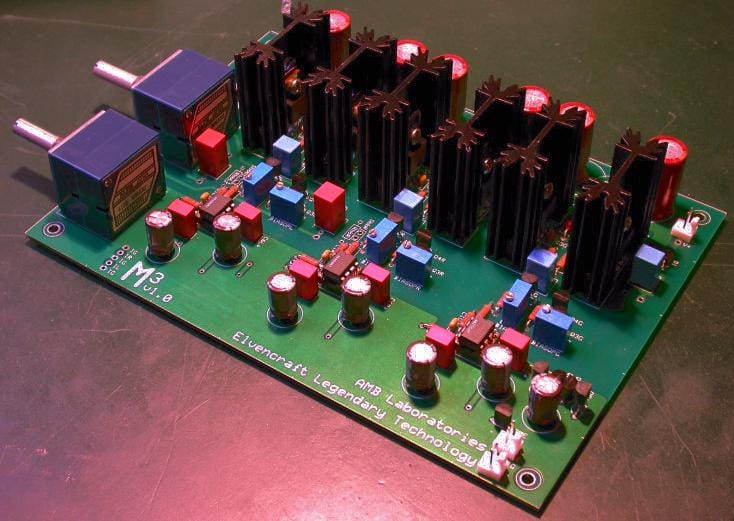
PROJECT SCOPE
The M³ project is primarily centered around the main headphone amplifier board. To build a working amplifier, you will also need a regulated DC power supply to provide power to this board, as well as select and/or build an enclosure chassis to house the amplifier board (and power supply, if the one you chose does not come with one). For further information see the Power supply section and the Parts list sections. Also, visit the AMB DIY audio forum to see what others are doing to build their M³ amplifiers.
Technical Highlights
3-channel active ground topology
In addition to the left and right channels, in this amplifier the “ground” wire of the headphone is actively driven by a third channel of the same topology. The ground channel amplifier sources or sinks the return current from the transducers, which would otherwise have been dumped into signal ground or power supply ground. This shifts responsibility for the high current reactive load of the headphones from signal ground to the tightly regulated power supply rails, thus removing the primary source of signal ground contamination. The headphone transducer “sees” symmetrical output buffers with equal impedance and transfer characteristics on both sides, rather than an output buffer on one side and a capacitor bank of the power supply ground on the other.
High performance opamp voltage gain stage and high current discrete MOSFET output stage
A high performance IC opamp is used for voltage gain duty in the M³ amplifier, while the discrete power MOSFET output stage provides the current gain to drive the headphones. This separation of functions isolates the headphone load from the opamp and allows it to operate without strain. Both stages operate in class A for unparalleled linearity. The MOSFET output stage has enough output power capability to drive efficient speakers to reasonable volumes.
For more details please refer to AMB Laboratories
sudo nano /var/lib/NetworkManager/NetworkManager.state
WirelessEnabled=false -> WirelessEnabled=true